1st
World Library
Break
|
  
Frequently Asked QuestionsWhat is an ISBN number? Why is it important? How do I get one? What is the Library of Congress Card Catalog Number? Do I need one? How do I get one? How does on-demand publishing different from traditional publishing? What's happened to the publishing industry recently? What if I want to contract with an author to come and speak to my organization? What is an ISBN number? Why is it important? How do I get one? The ISBN (International Standard Book Number) is a unique machine-readable ID number, specific to every book published. The ISBN format is defined and the numbering scheme has been in use for over 30 years throughout the international book-trade industry. Every book published by a recognized publisher has an ISBN number. These numbers are often encoded in a barcode somewhere on the back cover of the book. The number is assigned during production of the book and accompanies the publication from that point on. You cannot sell a book into the retail channel if it doesn't have an ISBN number. ISBN numbers are assigned through Bowker and the U.S. ISBN Agency. The minimum number of ISBN numbers that can be purchased at one time are ten. If you would rather not be bothered with this, Groundbreaking Press provides ISBN numbers to all our authors, we'd love to discuss the possibility of publishing yours. What is the Library of Congress Card Catalog Number? Do I need one? How do I get one? This is an ID number supplied by the Library of Congress and used by libraries throughout the United States. If you're planning on selling your book to libraries, it must have a Library of Congress Card Catalog Number. The easiest way to get a Library of Congress Catalog Number is through the Electronic PCN (Preassigned Control Number) program. This process is not as easy, nor is it as direct, as getting the ISBN number. You should begin the process as soon as possible, especially if this is your first book. How is on-demand publishing different from traditional publishing? The major difference is the dramatic savings in upfront publishing costs and the ability to maintain effective control over your inventory. With on-demand publishing, you can print the number of copies of a book you need, when you need them. With traditional publishing, you are forced to print a major quantity of books to get the per unit price down to a reasonable level. However, this means in order to be profitable, you have to sell most of what you print. In our experience, the first printing costs for on-demand publishing can be as little as 15% of the first printing costs of traditional publishing. Even better, if you sell the entire first printing, as low as 250 copies, you will make a nice gross profit. In fact, you will probably recoup all of your production costs (editing, copyediting, cover design, etc.) long before you've sold even 1000 copies. Another type of on-demand publishing is POD (Print-On-Demand) where bookstores order the books through Ingram Publishing and they are printed as needed, as few as one at a time. To take advantage of this service, which guarantees that all bookstores in the United States will have access to your book and that it will be available at all major on-line booksellers (i.e. Amazon and Barnes & Noble), your book will have to be published by a reputable publisher ... with Groundbreaking Press your publisher this problem is solved. What's happened to the publishing industry recently? This is a relatively brief answer leading to a more complete one; see Brad's white paper, "Traditional Publishing - How and Why It Works Like It Does". This question was asked by an author during her Validation Interview. What she really meant was, "I used to hear about authors finding a publisher, receiving large advances for their book, and then having the publisher spend money, time, and resources promoting their book with media tours and advertising. Why don't publishers do that anymore?" The truth is, it never worked this way except for the chosen few. But you hear about the authors who get the large advances and the media tours. So the assumption is, that must happen to all authors. Additionally, an author will tell the world when they find a publisher, while those struggling to find a publisher, suffering through rejection letter after rejection letter, tend to struggle in private. This is the way it's always been. The difference today is that authors have choices; they have many more publishers to choose from. This is the golden age of small publishers, with small publishing houses now generating over 50% of book sales in the United States. In addition, the new technology of on-demand printing and the ability to print short runs at reasonable prices both make it easier than ever to realize your dream of publishing a book.. What if I want to contract with an author to come and speak to my organization? Groundbreaking Press handles speaking engagements for Brad Fregger and all our published authors, contact: speakers@groundbreaking.com. If you would like to contact another author speaking before your organization, check the specific author's bio for contact information. What is the difference between hardcover, trade paperback (softcover), and mass-market paperback books?
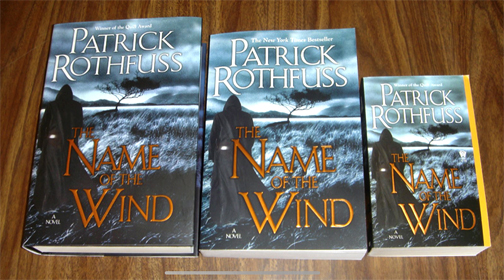
The hardcover has a stiff cover and comes with a dust jacket. It has a more substantial, high quality, feeling. The trade paperback has a softcover with the book’s cover printer right on the softcover. It is basically the same size as the hardcover with the same page count. It is priced lower and is much lighter. Both are printed on acid-free paper.
The difference between a trade paperback and a mass market paperback is just this: the mass market paperback is smaller, printed on low-quality paper, and is much cheaper. This version is only used for books that have a mass-market appeal.
Groundbreaking Press only offers hardcover, trade paperback (softcover), and the standard ebook (Kindle)
There are basically six ways a book can be presented for sale to the general public: hardcover, trade paperback, mass market paperback, ebook, unabridged audiobook, and abridged audiobook.
Below is an image showing the same book as a hardcover, a softcover, and a mass market paperback.
Authors serving authors ... All
material on this site Copyright © 2019 Groundbreaking Press |