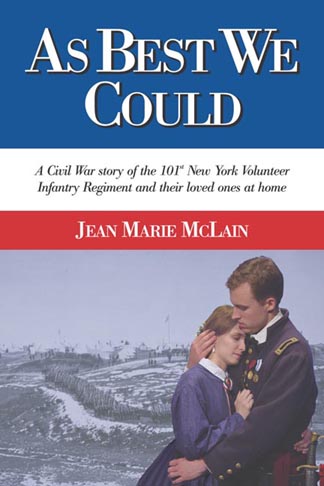
The
author brings the years of the United States
Civil War to life as you've never experienced
them before. Using letters sent between soldiers
fighting in the war and loved ones waiting at
home, she describes, in a clear and compelling
way, their thoughts and feelings as they live
through the most horrendous war America has ever
experienced.
You will fall in love with Mary and Jamie as
they slowly discover each other and a love that
will last a lifetime.
The story begins...
Just before Christmas, 1861, JAMES “JAMIE” Mc
NEIL, a young recruit in Captain Buckham’s
Sharpshooter Company at Delhi, New York, writes
a letter of apology to pretty MARY EDWARDS. He
had caused her to injure herself in an accident
two days before when he startled her horse. Mary
had tumbled off, and Jamie hopes she will
forgive him. Mary, a spirited young woman from a
farm near Meredith Square, replies pertly that
she cannot accept his apology for, she admits,
the mishap was entirely the fault of her own
Willful Nature. She had been scandalously riding
astride, and in scrambling to adjust herself
properly sidesaddle, had lost her balance and
fallen. “As Grandmother would say, I am a
foolish girl who got what was coming to me,” she
tells him. Jamie gallantly replies that she
should not believe she deserved what she got,
and that her fall was really very graceful.
So begins a correspondence that is to last
through nearly four years of war and suffering,
and will blossom into a love that will sustain
each of them in their most trying days.
Click here to read
Jamie's Gettysburg Letter to Mary.
Authors Note:
In any work of historical fiction, the author
is, by definition, mixing fact with fiction. To
tell a true story by using fictional characters
for the narration is always a tricky business.
The casual reader may enjoy the story without
question, but the historian always wants to
know, "How much of this is true? How much have
you invented?"
Although many of the people named in this work
were actual citizens and soldiers, the following
characters are fictional and any resemblance to
actual persons is entirely coincidental: Jamie
and his family, Mary and her extended family,
Dusty and his family, John Corrigan, Mark
Hammond, Lucien, and Nurse MacAlpin. Although
Ransom Mitchell was a real person, he was not as
portrayed but was, at the time, a man in his
40's with a wife and four children. He was
Marshall Mitchell's brother, not his nephew.
However, he was drafted as mentioned.
The majority of details about the regiments are
based on facts presented by real soldiers in
letters, diaries, memoirs, The Official Records
of the Rebellion, and reports of the Adjutant
General of the State of New York. I have tried
to capture the trend of the soldiers' actual
thoughts and feelings as the events unfolded. A
few of the minor incidents are fiction and, of
course, Jamie's role in all the events is
entirely fiction.
The majority of details about life in Delaware
County--the citizens, events, weather, and farm
chores--are factual, based on census
information, newspaper accounts, historical
records, and diaries. Every effort has been made
to tell the story as it might have been told by
real people at the time using their language,
sentiments, and knowledge of events. Even though
the main characters are fictional, their
thoughts and the incidents of their lives are
normal and common for that time and place.
I have taken some liberties with certain events,
such as the dates of the deaths of Charlie
Christmas (actual death: November 14, 1863) and
of the two young Thompson boys (actual deaths:
George, February 10; Buckley, February 21,
1864). I have also invented a few details about
Philo Benedict that fill out his story and, I
hope, do not offend. The Willing Workers is a
real organization that existed in West Meredith
for the purpose of maintaining the cemetery
there. Although it was in existence in the 19th
century, I do not know its origins, so its role
in the war effort is fictional, as is its
placement in Meredith Hollow (present day
Meridale.) The descriptions of Independence Day
celebrations in Meredith Square are fiction
although the celebrations mentioned elsewhere
are factual.
Some of the letters seem to be written by real
citizens to fictional characters. These are, of
course, fiction, and meant only to fill out the
story, not to mislead or confuse. However,
General Birney's Letter of Commendation for the
Kearny Cross is a direct facsimile, as is the
letter from General Hancock to General Meade at
Petersburg, both quoted from The Official
Records of the Rebellion. Jamie's military
papers are direct facsimiles of actual documents
issued.
I hope the citizens of Meredith Township,
Delaware County, and the descendants of the
soldiers who served in the 101st, 37th, and 40th
New York Infantries will forgive me for the
liberties I have taken in telling the story of
their ancestors. It has been my honor to say so
many of their names once more, after more than
140 years of silence, and to put those names in
print for all to see. I wish I could have
mentioned them all.
Jean Marie McLain
Austin, Texas
October 2002
Book Signing -
Photo of the launch of As Best We Could
book signing.
Read! -
What readers
are saying about As Best We Could.
Listen! - Listen to an interview of
Jean Marie McLain on KUT radio (Austin, TX).
The interview was played on the air, Monday,
February 17th.